Naxi Cultural Attractions: Top Heritage Sites to Visit
2026-09-22
Most travelers come to Lijiang for the old town's cobblestones, but stay for something deeper: the Naxi culture that still pulses through the valleys. This isn't a culture preserved in glass cases—it's in the Dongba scripts carved on wooden doors, the echo of ancient music at dusk, and the terraced springs of Jade Water Village, where the past feels less like a museum and more like a neighbor. If you're ready to go beyond the usual photo stops, here are the Naxi heritage sites that show you why this corner of Yunnan is unlike anywhere else.
Wandering Lijiang Old Town's Naxi Labyrinth
Lijiang Old Town doesn't unfold in straight lines. Its narrow stone alleys twist past wooden shopfronts, over tiny arched bridges, and around corners that hide courtyards filled with potted orchids. The moment you step away from the main square, the grid disappears. You're inside a Naxi-built maze, where the path splits and rejoins without warning, and every turn feels like a small act of trust.
Water is the quiet guide here. Clear streams run alongside the lanes, sometimes vanishing beneath flagstones, then reappearing as a shallow channel that flows past a doorway or under a willow. Locals still wash vegetables at the water's edge, and the sound of it moving over stones becomes your companion as you wander. If you get lost, which you will, the water offers a loose orientation—follow it downstream and you'll eventually find your way back toward the larger canals.
The Naxi influence lingers in the details: carved lintels, painted panels with Dongba pictographs, and women wearing the traditional blue apron with its seven embroidered circles. But this isn't a museum. The maze is alive with teahouses, bakeries, and workshops where silver is hammered by hand. Let yourself drift without a map for an hour. The reward isn't reaching a destination; it's the moment you glance up and realize you have no idea which century the alley belongs to, and that not knowing is exactly why you came.
Baisha Murals Still Breathing in Local Temples
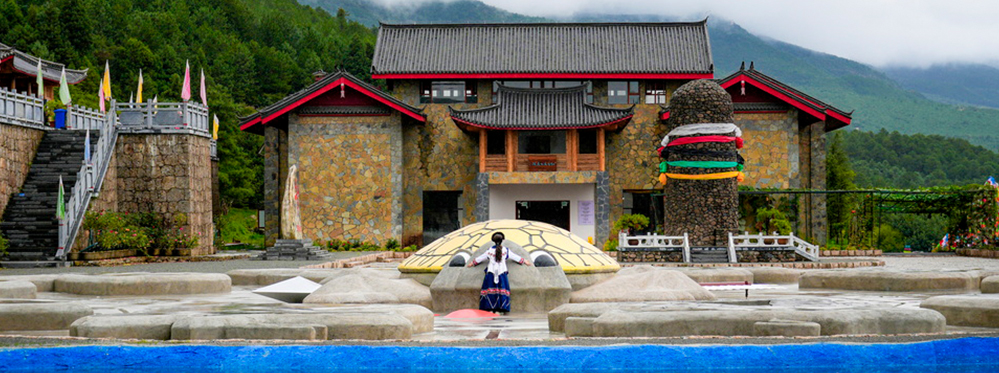
Inside the Dabaoji Hall and the Liuli Hall in Baisha village, the murals do not sit behind museum glass. They stay on the original plaster walls of working temples, where incense smoke drifts past painted bodhisattvas and faded donors, and the smell of old wood mixes with mineral pigments.
The colors were ground from local stones, so the reds and greens have not simply crumbled into dust. They deepen with age, catching the low light that filters through lattice windows. On quiet afternoons, a caretaker might sweep the stone courtyard, and the sound blends with the centuries-old silence of the paint.
What keeps these murals alive is their unfinished conversation with daily life. Villagers still leave small offerings near the thresholds, and a faint trace of butter lamps lingers in the air. The images are not locked away—they breathe with the temple, sharing space with footsteps, prayers, and the slow passage of seasons.
A Ming Dynasty Camellia at Yufeng Temple
In the quiet courtyard of Yufeng Temple, just north of Lijiang’s Old Town, stands a camellia tree that has witnessed more than five centuries of change. Planted during the Ming Dynasty, this ancient specimen is often called the "Ten Thousand Flower Camellia," though its true magic lies not in a single season but in its layered history. Local records suggest the tree was originally cultivated by a monk who tended the temple grounds, and over time it has become a living bridge between the region's Naxi traditions and the natural world.
Each spring, the old branches erupt with blossoms that can number in the tens of thousands, creating a canopy of deep red and soft pink. What makes the tree particularly unusual is its habit of producing flowers with slightly different petal counts and color intensities on the same plant, a trait attributed to centuries of careful grafting. Visitors often pause beneath the twisted limbs, not just to photograph the blooms, but to feel the quiet endurance of a tree that has survived wars, weather, and the steady march of time while remaining rooted in the same spot.
Shuhe Village Keeps the Tea Horse Road Alive
Morning light spills over cobbled lanes where mule bells once rang. In Shuhe, the old caravan town north of Lijiang, the Tea Horse Road is not a museum piece — it is a pulse. Farmers still lead horses past stone bridges worn smooth by centuries of hooves, and the scent of pu'er drifts from courtyard workshops where tea cakes are pressed by hand, just as they were when traders shouldered loads toward Tibet.
Walk beyond the renovated square and you will find quiet corners where the route refuses to fade. A blacksmith taps out horseshoes beside a canal, while an elderly Naxi woman recounts how her grandfather ferried salt and brick tea across snow passes. The village does not merely commemorate the old trade; it lives in the cadence of daily work — leather harnesses hanging in doorways, mule trains grazing on the outskirts, and guesthouses named after vanished caravanserais.
Shuhe's endurance comes from this refusal to package history as scenery. Instead, the road survives in the ordinary: a bowl of butter tea shared with a horseman, the creak of a wooden cart at dusk, the way blue mountains still frame the same horizon that once guided travelers home. Here, the Tea Horse Road is not something to be remembered. It is something that simply continues.
Reading Dongba Script in Its Quietest Museum
The floorboards don't creak here, and the air hangs so still you can hear the faint rustle of your own sleeve against the display case. In this almost forgotten corner of the old town, the museum keeps its lights low, not to protect fragile paper alone, but to invite you to lean in close. There is no audio guide, no crowd pressing from behind — just rows of glass cases holding rice paper covered in creatures, trees, and tiny spirals that look more like children's drawings than a writing system.
Dongba script refuses to behave like a dead alphabet. Each glyph is a small act of seeing: a circle with rays for the sun, a wavy line for water, a seated figure for a person. What surprises most visitors is that these symbols are not fixed ornaments. A cup might tilt a little to the left in one manuscript, sprout a handle in another, depending on the hand of the priest who inked it. The script breathes through such irregularities, as if every reading is a fresh negotiation between the eye and the symbol.
You find yourself tracing the glass with a fingertip, quietly pronouncing the words the museum has printed beside a strip of chanted verse. The syllables feel foreign but not remote. Somewhere behind a locked door, a recorded voice hums the same lines in the Naxi tongue, and for a moment the room loses its museum stillness. Then the voice fades, the dust re-settles, and you step back, aware that you have just read something older than the building, older than the town, yet not older than the impulse to turn the world into pictures.
Black Dragon Pool Holds Jade Dragon Snow Mountain in Its Waters
The water at Black Dragon Pool does more than mirror the sky—it carries the entire mass of Jade Dragon Snow Mountain, holding the peak upside down so steadily that only a ripple separates the real summit from its reflected twin. On calm mornings, the surface turns into a sheet of dark glass, and the mountain appears to be sinking into the pool rather than towering above it. Even the snowfields and ridge lines stay sharp enough to count, as if the pool were a second, liquid mountain range.
This effect is strongest just after sunrise, before wind roughens the water. The pool's mineral-rich springs keep it unusually clear, and the angle from the north shore lines up the highest glacier with the deepest part of the basin. Local photographers often wait for the moment when the sun hits the snow but leaves the pool in shadow—then the reflection glows brighter than the sky behind it, and the mountain seems lit from below the surface.
Framing the scene are the white marble arches of the Five-Phoenix Bridge and the upturned eaves of the Deyue Pavilion, which sit at the pool's edge. Their reflections mingle with the mountain's, creating a layered composition that changes by the minute. In spring, fallen pear petals drift across the water and break the reflection into fragments, while in winter the pool rarely freezes, so the mountain remains doubly present even in the coldest months.
FAQ
Shuhe Old Town feels far less polished than Lijiang's main old quarter. Its narrow cobbled lanes still have Naxi women washing vegetables in the canals and elderly men playing cards under old walnut trees, especially near the Qinglong Bridge early in the morning.
Painted mostly during the Ming dynasty, the murals blend Han Chinese, Tibetan, and Naxi artistic traditions in a single wall. You can spot Taoist immortals, Buddhist bodhisattvas, and local Naxi deities side by side, which reflects how the ruling Mu family balanced different religious communities.
In Naxi belief, the mountain is the home of Sanduo, the protector deity of the Naxi people. The Dongba scriptures describe it as a warrior turned to stone, and many Naxi still burn incense at its foothills before major life events like weddings or long journeys.
Yushui Village, tucked into the foothills north of Lijiang, hosts Dongba priests who still chant, dance, and perform purification rites for visitors and local families. The village also keeps a sacrificial altar and a spirit wall where wooden prayer flags are replaced each lunar month.
The museum holds over a thousand original Dongba manuscripts and runs a small classroom where retired Dongba scribes teach the pictographic script to children and curious travelers. You can practice writing simple symbols like 'sun' and 'mountain' with bamboo pens on handmade paper.
Lijiang was a major trading hub where mule caravans swapped tea for Tibetan horses and salt. The old market square, Sifangjie, still has stone hitching posts, and the narrow lanes leading northward show grooves worn into the flagstones by loaded mules over centuries.
Black Dragon Pool Park does this beautifully. The five-arch bridge and the Moon-Embracing Pavilion were built to frame the reflection of Jade Dragon Snow Mountain in the water, and the nearby Dragon God Temple holds old stone tablets inscribed with Naxi water-management rules.
Baisha village, beyond the famous murals, has small family workshops where you can try beating mulberry bark into Dongba paper or carving simple wooden printing blocks used for Naxi New Year door gods. A few artisans also teach basic copper inlay techniques on a foot-powered lathe.
Conclusion
Stepping into Lijiang Old Town feels less like sightseeing and more like losing yourself in a living Naxi labyrinth—cobbled lanes curve past wooden houses, canals whisper under stone bridges, and elderly locals still gather in squares for morning chatter. A short ride north, Shuhe Village keeps the old Tea Horse Road breathing: saddles and bridles hang outside workshops, and the clip-clop of hooves on stone recalls caravans that once hauled tea into Tibet. Just outside town, Black Dragon Pool offers a moment of stillness. On clear days, Jade Dragon Snow Mountain's peaks double themselves in the jade-green water, framed by willows and the Moon-Embrace Pavilion—a view that has inspired Naxi poets for centuries.
For deeper layers of Naxi heritage, head to Baisha, where faded murals in small temples still pulse with color and tact. Painted during the Ming dynasty, they blend Tibetan, Han, and Naxi styles—bodhisattvas, guardians, and local donors share the same walls without a hint of conflict. Nearby, Yufeng Temple guards a camellia tree planted in the Ming era; every spring its ten thousand blossoms turn the courtyard into a crimson cloud, a quiet miracle of survival. End at the Dongba Script Museum, the most understated stop of all. Here, the world's only living pictographs—bird, moon, mountain, person—are carved on wooden slips and handmade paper. The silence is intentional, letting you read a script that has whispered Naxi beliefs for a thousand years.
Contact Us
Contact Person: Changhong He
Email: [email protected]
Tel/WhatsApp: 086-0888-5190152
Website: https://vip.e-baixing.com/ysh