
China Small Magnet Essential Guide for Global Buyers
2026-08-30
Ordering small magnets from China usually starts with a simple search and ends with a spreadsheet full of near-identical quotes. The real differences hide in the details: gauss levels, plating thickness, and whether the supplier actually inspects every batch. DAWA has spent years cutting through that noise for buyers who can’t afford rework or recalls. This guide strips away the guesswork—covering grade selection, meaningful test data, and the three costliest missteps—so your next purchase feels less like a gamble.
What Actually Determines Magnet Strength
Many people assume a magnet's strength is just about its size or weight, but the real driver is the material's intrinsic magnetic properties—specifically its remanence and coercivity. A neodymium magnet, for instance, can be several times stronger than a ferrite magnet of the same dimensions because its crystal structure allows a much higher magnetic energy product, meaning more magnetic energy is stored per unit volume.
Another crucial factor is how well the magnetic domains are aligned. When a magnet is manufactured, the alloy is exposed to a strong external field during the pressing or sintering process, which forces the microscopic domains to line up in one direction. Any misalignment, impurities, or poor sintering can leave domains pointing randomly, directly reducing the net external field. Temperature also plays a role: above a certain threshold—the Curie temperature—the thermal motion destroys the alignment entirely, but even before that, elevated temperatures can lower coercivity and weaken the magnet temporarily or permanently.
Finally, the shape and orientation of the magnet affect how much useful strength you actually get. A long, thin magnet will typically exhibit a higher surface field than a short, thick one of the same volume because it minimizes the internal demagnetizing field that fights against the magnetization. So if you're comparing magnets, you have to look beyond the pull force ratings and consider the material grade, the magnetization direction, and the physical geometry as a complete system.
Why Cheap Neodymium Often Costs More Later
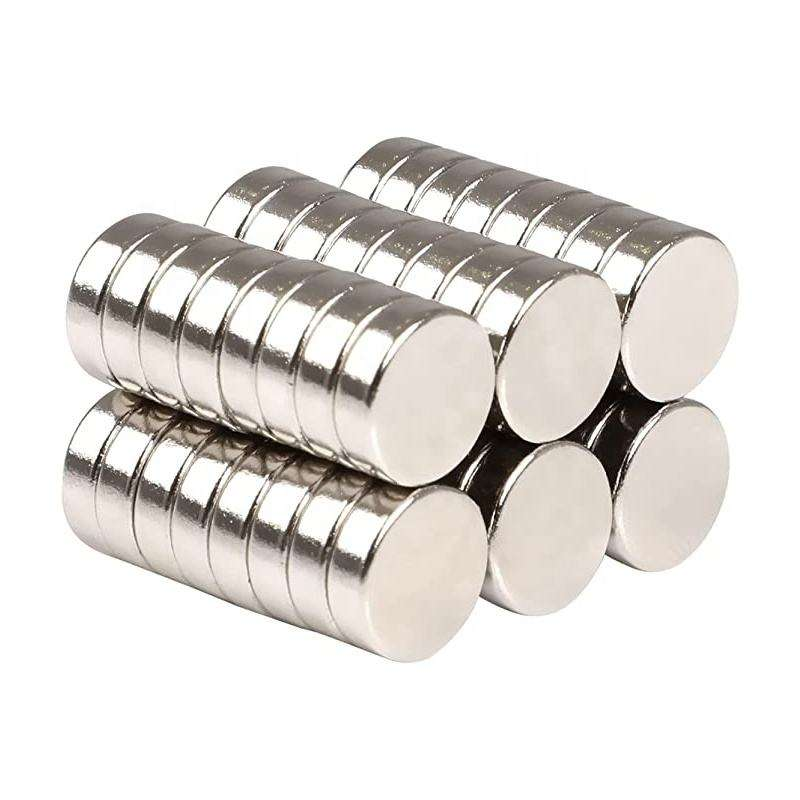
Many buyers treat neodymium magnets as a commodity, grabbing the lowest quote without checking performance specs. A magnet that costs half as much up front often carries hidden flaws: thinner nickel coating, looser dimensional tolerance, or lower coercivity. In a closed-loop motor, that translates to faster demagnetization under heat, which silently degrades torque and efficiency over a few hundred operating hours.
The real expense shows up when a failed magnet forces a teardown. Replacing a $0.50 magnet inside a $400 actuator means labor, downtime, and possibly scrapping the whole assembly if adhesive or housing gets damaged. Cheap magnets also tend to have inconsistent plating, so rust particles can flake off and contaminate nearby electronics. Those warranty claims and rework orders erode the initial savings many times over.
Sourcing teams that track lifetime costs rarely stick with bargain magnets for long. They learn to ask for grade certification and batch test reports, because a supplier cutting corners on raw material won't absorb the cost of field failures. Paying a bit more for a certified N52 or N42 with proper coating usually yields a lower failure rate and fewer end-user complaints, which is where the true cost difference lives.
Reading Between the Lines of Supplier Spec Sheets
A spec sheet can feel like a clean contract, but the most critical details often live in its margins and footnotes. Take a MOSFET's on-resistance: the headline number might be quoted at 25°C, yet in a real power supply the junction temperature easily climbs past 100°C, pushing that resistance up by 50% or more. Instead of trusting the bold print, experienced engineers flip to the characteristic curves and trace the behavior at their actual operating point. The absence of a curve for your specific condition is itself a warning sign.
Test conditions are another place where suppliers quietly gain an edge. Two competing capacitors may both claim a 10,000-hour lifetime, but one is rated at 105°C with rated ripple current while the other uses 85°C and no ripple. The numbers become meaningless without aligning the fine print. Similarly, a ±5% tolerance on a reference voltage might hide a temperature coefficient that shifts the output by another 2% across a normal indoor range. Always normalize the measurements before comparing parts, or you'll end up designing around a fantasy.
Then there is the word 'typical,' which often means 'best case from a small engineering sample.' Typical values rarely reflect production spread or end-of-life drift. A supplier may omit long-term stability data or bury it in an application note that contradicts the main table. When a critical parameter seems too good, look for what was not measured: humidity, board flex, thermal cycling, or aging under bias. The real specification is not what the sheet says, but what it refuses to say plainly.
The Hidden Variables in Coating and Plating
Most process engineers track thickness, bath temperature, and current density as if those were the whole story. Yet the real drift often comes from variables nobody puts on a control chart: the way a rack's contact points wear unevenly over weeks, how a brightener's breakdown products accumulate and shift the cathode film, or the subtle change in rinse water conductivity after a rainstorm alters the local water supply. These quiet factors don't announce themselves until a batch fails adhesion testing or corrosion resistance drops a full salt-spray cycle.
Another layer of hidden influence lives in the substrate itself. Two identical steel parts from different suppliers can carry different residual stress patterns, micro-inclusions, or even a faint oxide skin that survives alkaline cleaning only to disrupt nucleation during the first seconds of deposition. Operators rarely see this because the part looks the same going into the bath. The coating doesn't care about the drawing number; it responds to the actual surface energy and electrical continuity at every microscopic pit and grain boundary.
Finally, the electrolyte ages in ways that standard titration misses. Organic additives can form oligomers that plate out sporadically, or an anode bag can shed fibers that create local shielding. A rack that was perfectly conductive yesterday may develop a thin, resistive film from dried drag-out salts. These hidden variables explain why two shifts running the same recipe on the same line can produce visibly different finishes—and why the most reliable shops track not just the obvious parameters, but the fingerprints of their own process history.
Packaging That Survives Sea Freight Without Magnet Damage
Sea freight exposes packaging to prolonged vibration, salt spray, and temperature swings, but the hidden threat to sensitive cargo is magnetic interference. Strong magnets in closures, latches, or even nearby machinery can degrade data stored on hard drives, strip magnetic strips on cards, or disrupt calibrated instruments. To survive the voyage, packaging must create a physical buffer—using non-ferrous materials like aluminum or copper, and strategically placing ferromagnetic shields to redirect stray fields away from the payload.
Most conventional boxes rely on foam or bubble wrap, which stop shock but do nothing against a 50-gauss stray field. A smarter approach is to build a modular inner cage from mu-metal or permalloy sheet, then suspend it with elastomeric mounts that decouple both vibration and magnetic coupling. Test chambers that simulate rolling seas—combining a Helmholtz coil with a shaker table—reveal whether your package truly holds up, because a magnet can quietly erase a cargo’s value while the box looks perfectly intact on arrival.
Beyond passive shielding, consider the geometry of the load. Place sensitive items at the geometric center, where field lines are most diffuse, and avoid stacking them near steel container walls. For long-haul routes through equatorial zones, temperature cycling can cause ferrous components to become temporarily magnetized, so use only degaussed hardware in the packaging itself. After unloading, a field meter check on the dock costs less than a single returned shipment.
Building a Repeatable Quality Check Before You Commit
A repeatable quality check starts with writing down the exact steps you take before every commit. Instead of relying on memory, put together a short checklist that covers formatting, unit tests, and a quick scan for debug code or leftover comments. The goal is to make the process boring and predictable, so you catch the same classes of mistakes each time without extra mental effort.
Once the list is stable, turn it into a script or a set of commands you run in the same order. If a step fails, the script stops and tells you exactly what broke. Over time, this becomes a safety net that fits into your workflow without slowing you down. You can also store the output as a log, which makes it easier to spot patterns when a particular check keeps failing.
The real value shows up when you are tired or under pressure. A repeatable check keeps the standard from slipping just because you are in a hurry. It is not about catching every possible issue, but about making sure the basics are always covered and that you can commit with more confidence.
FAQ
Ask for the exact grade and coating first, not just 'strong magnet.' For tiny parts, a missing nickel-copper-nickel layer or an inaccurate N35 vs N52 claim changes pull force and corrosion life. Request a dimensional drawing with tolerances before sampling, and confirm whether the magnetized direction matches your assembly.
If space is tight and you need holding force in a small volume, neodymium usually wins, but it will cost more and may need a protective coating. Ferrite is cheaper and corrosion-resistant, yet it is much weaker for the same size. Many buyers only compare price per piece and miss that ferrite may force a larger housing.
Not automatically. Reputable factories can supply test reports for lead, cadmium, and SVHC, but some traders just forward outdated certificates. For small magnets, the plating and any adhesive or plastic carrier also matter. Ask for a lab report that matches the actual product SKU, not a generic company certificate.
Custom shapes often start around 1,000 to 5,000 pieces depending on tooling and size. If a supplier says any quantity with no setup fee, you are probably paying for a stock size that is being modified or simply relabeled. For true custom tooling, expect a one-time mold or fixture charge and a longer lead time.
Request a pre-shipment inspection on samples pulled from production lots, not from a pre-approved golden sample. Ask for a gauss reading on multiple units or a pull-force test record. For plated magnets, a salt spray test reference helps, but the simplest check is a visual exam for pinholes and uneven edges.
It is possible if the packages are shielded and the outer carton keeps stray magnetic fields below the carrier limit. Weak surface fields from small magnets still add up in a bulk carton. Use a steel sheet liner or individual magnetic shielding, and check the carrier's maximum field strength rule before booking.
Ask about the pressing direction, sintering process, or coating line, not just the catalog size. A factory can explain how a small ring magnet is pressed and how they remove burrs; a trading company will usually repeat general marketing terms. You can also request a photo or video of the actual production line with your order number written on a card.
Tight tolerances are expensive and often unnecessary. For a 3mm disc, a ±0.05mm tolerance is common, while ±0.1mm is easier to source. Define the critical dimension only, such as the outer diameter that fits a bore, and allow looser tolerances on the thickness unless it affects air gap. Specify this on the drawing before pricing.
Conclusion
Most buyers assume a small magnet's pull force comes down to its N-rating, but the real story lives in the demagnetization curve, coercivity, and how the material behaves at the actual working temperature. A N52 block that loses half its strength at 60°C is far weaker in practice than a lower-grade magnet with added dysprosium or terbium. Cheap neodymium often skips those heat-stabilizing elements or uses recycled powder with inconsistent grain structure, so the initial savings disappear when devices fail in the field or require costly rework. Supplier data sheets add another layer of confusion: they may quote closed-circuit remanence instead of open-circuit pull force, or omit the air gap and coating thickness that change real performance. Reading between those lines means asking for test conditions, not just the headline grade.
Coating and plating carry hidden risks you will never see in a photo. A thin or uneven nickel-copper-nickel layer, missing passivation, or rough edges that expose the base alloy can lead to corrosion within weeks in humid environments. Sea freight packaging is equally critical because strong magnets attract each other through cardboard and can chip, crack, or even alter polarity if not separated with proper spacers and magnetic shielding. Before committing to a large order, build a repeatable quality check: pull-force testing on a calibrated rig, coating thickness measurement, salt-spray exposure, and batch-to-batch consistency reviews. This kind of upfront discipline reveals whether a supplier truly controls their process or just ships whatever comes off the line. It is the only way to avoid turning a low per-unit price into a long-term liability.
Contact Us
Contact Person: Kelvin Lo
Email: [email protected]
Tel/WhatsApp: 0769-88561131
Website: https://dawamagnetic.com/